
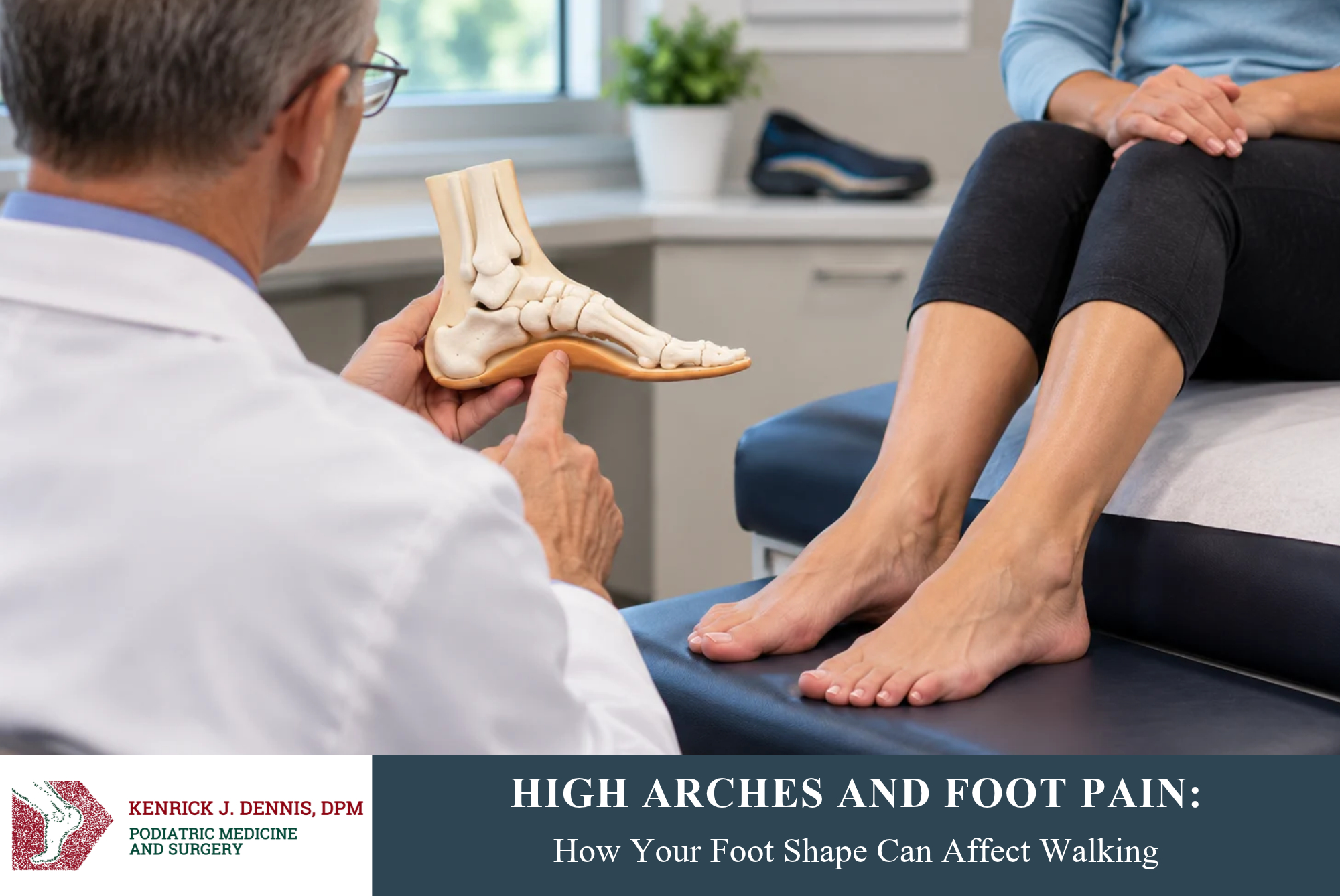
The shape of your feet influences how weight is distributed during standing, walking, and running. While some people have naturally low arches, others have unusually high arches, a condition called pes cavus.
High arches do not always cause symptoms. However, certain high-arched feet may be less flexible and place increased pressure on the heel, ball of the foot, and outer border of the foot.
At Kenrick J. Dennis, DPM, Dr. Ken Dennis evaluates foot structure and walking mechanics to identify factors contributing to discomfort.
What Are High Arches?
A high-arched foot has an elevated medial longitudinal arch, sometimes even when standing.
Some high-arched feet are flexible, while others are relatively rigid.
The degree of arch height alone does not determine whether treatment is necessary.
What Causes High Arches?
High arches may develop because of inherited foot structure.
In some individuals, pes cavus is associated with neurological or neuromuscular conditions, including hereditary peripheral neuropathies.
A newly developing, progressively worsening, or markedly one-sided high arch may require additional neurological evaluation.
How Can High Arches Cause Foot Pain?
High arches may concentrate pressure beneath the heel and metatarsal heads.
Certain foot alignment patterns can increase stress along the outside of the foot and ankle, potentially contributing to recurrent ankle sprains or peroneal tendon problems.
Patients may also develop calluses, claw toes, or difficulty finding comfortable footwear.
How Are High Arches Evaluated?
A podiatric examination may include assessment of foot flexibility, alignment, muscle strength, sensation, and gait.
Weight-bearing X-rays can help characterize structural abnormalities.
Neurological testing may be recommended when weakness, progressive deformity, or a family history suggests an underlying nerve disorder.
What Treatments Can Help?
Treatment depends on symptoms, foot flexibility, and the underlying cause.
Supportive footwear, cushioning, pressure-relieving insoles, and appropriately designed orthotics may improve comfort.
Physical therapy may address muscle imbalance, ankle stability, and functional limitations.
Rigid deformities or severe instability may require more advanced treatment.
Frequently Asked Questions About High Arches
Are High Arches Bad for Your Feet?
Not necessarily. Many people have high arches without significant pain or functional limitations.
Can High Arches Cause Ankle Sprains?
Certain high-arched foot alignment patterns may increase susceptibility to lateral ankle instability.
Are Orthotics Helpful for High Arches?
They may improve pressure distribution and stability when selected for the individual’s foot structure.
Can High Arches Cause Pain in the Ball of the Foot?
Yes. Increased forefoot loading may contribute to metatarsal discomfort.
When Should High Arches Be Evaluated?
Seek assessment for persistent pain, progressive deformity, weakness, frequent ankle sprains, or changes affecting only one foot.
Contact Information
Kenrick J. Dennis, DPM Dr. Ken Dennis 902 Frostwood, Suite 250 Houston, TX 77024
Phone: (713) 465-8833 / (281) 469-2676 Website: www.kdfoot.com Make an Appointment: Schedule an Appointment