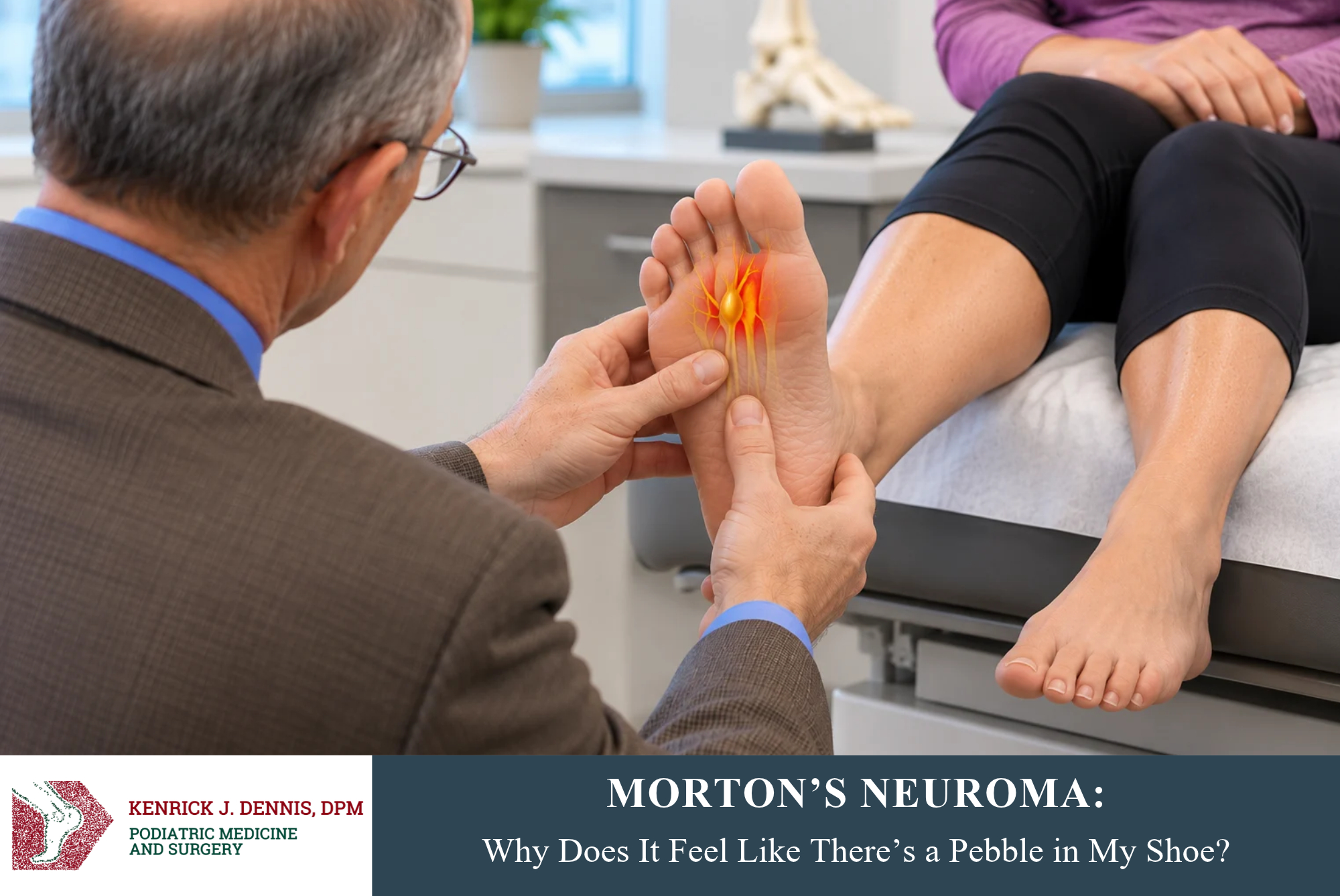
Have you ever felt as though you were walking on a small stone, a folded sock, or an uncomfortable lump inside your shoe, even though nothing was there? This unusual sensation may be caused by Morton’s neuroma, a painful condition affecting a nerve in the forefoot.
Morton’s neuroma commonly develops between the third and fourth toes, where irritation and thickening of tissue surrounding a nerve can cause burning pain, tingling, or numbness.
At Kenrick J. Dennis, DPM, in Houston, Texas, Dr. Ken Dennis evaluates forefoot pain and helps patients understand available nonsurgical and surgical treatment options.
What Is Morton’s Neuroma?
Morton’s neuroma is a compressive neuropathy involving a common plantar digital nerve. Despite its name, it is not typically a true nerve tumor.
Repeated pressure or irritation may contribute to changes in the tissue surrounding the nerve. The resulting symptoms can become more noticeable when walking or wearing narrow shoes.
What Causes Morton’s Neuroma?
Several factors may increase pressure on the nerves in the ball of the foot.
Narrow toe-box shoes can compress the metatarsal heads and surrounding soft tissues. High heels shift additional weight toward the forefoot, potentially aggravating symptoms.
Certain foot mechanics, repetitive activities, and forefoot deformities may also contribute to nerve irritation, although the exact cause is not always identifiable.
What Are the Symptoms of Morton’s Neuroma?
Common symptoms include burning or sharp pain in the ball of the foot, tingling into adjacent toes, numbness, and the sensation of a pebble beneath the foot.
Symptoms frequently worsen with prolonged walking, running, or wearing tight shoes. Removing footwear and gently massaging the forefoot may temporarily reduce discomfort.
Unlike some other foot conditions, Morton’s neuroma does not usually produce a visible lump.
How Is Morton’s Neuroma Diagnosed?
Diagnosis generally begins with a physical examination and discussion of symptoms.
A podiatrist may apply pressure across the forefoot or between the metatarsal bones to reproduce discomfort. In some cases, ultrasound or MRI may help evaluate the affected nerve or exclude other causes of pain.
Conditions such as metatarsalgia, stress fractures, plantar plate injuries, and inflammatory arthritis can produce similar symptoms.
What Treatments Are Available?
Initial treatment commonly focuses on reducing pressure around the affected nerve.
Shoes with a wide toe box, lower heels, and appropriate cushioning may improve comfort. Metatarsal pads or orthotics can help redistribute pressure when correctly positioned.
Other options may include activity modification, physical therapy, and selected injections.
When symptoms remain severe despite appropriate conservative care, surgical treatment may be considered. Procedures may involve releasing surrounding structures or removing the affected nerve segment, depending on the clinical situation.
Surgery can provide relief for selected patients but carries risks, including persistent pain or permanent numbness.
Can Morton’s Neuroma Go Away Without Surgery?
Some patients experience meaningful improvement with footwear changes and pressure reduction. However, persistent nerve-related symptoms may require additional treatment.
Early evaluation can help distinguish Morton’s neuroma from other forefoot conditions and guide an appropriate treatment plan.
Frequently Asked Questions About Morton’s Neuroma
Is Morton’s Neuroma a Tumor?
No. Morton’s neuroma is generally a benign nerve-related condition rather than a cancerous growth.
Which Toes Are Most Commonly Affected?
The condition most often affects the nerve between the third and fourth toes, although other spaces can be involved.
Can Morton’s Neuroma Cause Numbness?
Yes. Compression and irritation of the affected nerve can cause tingling or reduced sensation in neighboring toes.
Do Orthotics Help Morton’s Neuroma?
Appropriately designed orthotics or metatarsal pads may reduce forefoot pressure and improve symptoms in some patients.
Is Surgery Always Necessary?
No. Many patients begin with conservative treatment. Surgery is generally reserved for persistent symptoms that do not respond adequately to nonsurgical care.
Contact Information
Kenrick J. Dennis, DPM Dr. Ken Dennis 902 Frostwood, Suite 250 Houston, TX 77024
Phone: (713) 465-8833 / (281) 469-2676 Website: www.kdfoot.com Make an Appointment: Schedule an Appointment